|
|
|
   |
|
Orbiter discovers evidence of primordial ocean on Mars STEPHEN CLARK SPACEFLIGHT NOW Posted: 08 February 2012 
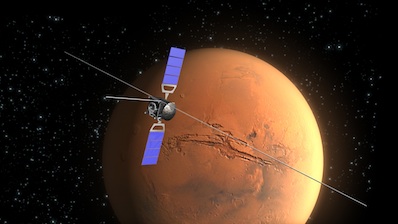
The radar on Europe's Mars Express orbiter detected sediments beneath the red planet's surface strongly indicative of an ocean floor that formed billions of years ago, scientists announced this week.
Another scenario involves a temporary sea that formed when a large comet or asteroid struck Mars, melting subsurface ice and creating outflow channels draining the water into a giant basin. The material was discovered by the MARSIS radar on Mars Express. Jeremie Mouginot, a researcher at the Institut de Planetologie et d'Astrophysique de Grenoble in France and the University of California, Irvine, and colleagues analyzed more than two years of data and found that the northern plains of Mars are covered in low-density material. "We interpret these as sedimentary deposits, maybe ice-rich," Mouginot said. "It is a strong new indication that there was once an ocean here." Imagery from satellites circling Mars have shown formations resembling ancient shorelines before, but scientists using Mars Express may have found the floor of a primordial ocean. "Previous Mars Express results about water on Mars came from the study of images and mineralogical data, as well as atmospheric measurments," said Olivier Witasse, ESA's Mars Express project scientist. "Now we have the view from the subsurface radar. This adds new pieces of information to the puzzle, but the question remains: where did all the water go?" Analysis of radar data from the MARSIS instrument can reveal the density of material up to 200 feet beneath the Martian surface. The material thought to be evidence of an ancient ocean shows low radar reflectivity, and such sediments are usually granular and have a low density, according to the European Space Agency. "This work provides some of the best evidence yet that there were once large bodies of liquid water on Mars and is further proof of the role of liquid water in the Martian geological history," an ESA statement said. |
|
|
|
|