

|
|
|
   |
|
Clearing the dust in the Carina Nebula DR EMILY BALDWIN ASTRONOMY NOW Posted: 08 February 2012 
The most detailed portrait of the Carina Nebula star-forming region has been captured by ESO's Very Large Telescope (VLT), revealing hundreds of thousands of never-before-seen stars.  A view of the Carina Nebula in visible light (bottom, by the MPG/ESO 2.2-metre telescope at the La Silla Observatory) and infrared (top, by the HAWK-I camera on ESO’s Very Large Telescope). Image: ESO/T. Preibisch. This beautifully intricate stellar nursery lies 7,500 light years from Earth and boasts some of the brightest and heaviest stars known, including Eta Carinae, seen in the lower left of the new image, and poised to explode in a dramatic supernova event as it nears the end of its short life. Impressive at visible wavelengths, the VLT, equipped with the infrared sensitive HAWK-I camera, has penetrated the thick swaths of dust that cocoon newly forming stars to reveal the nebula in infrared, bringing out hundreds of thousands of stars that were previously hidden. One such grouping of yellow-coloured stars can be seen towards the left of the mosaic, and is the first time that this group has been seen. 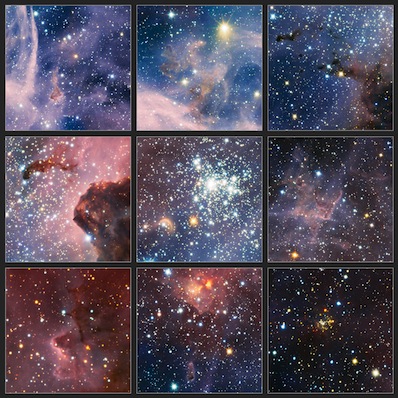 Details from the new VLT image of the Carina Nebula. Star cluster Trumpler 14 lies in the centre panel, with a strange golden crescent-shaped cloud. The cutout at the centre of the bottom row features a dark cloud known as the caterpillar at the bottom and obscured young stars at the top. The newly discovered cluster of yellow stars are revealed in the bottom right panel. Image: ESO/T. Preibisch. Some dense blobs of gas and dust are even impenetrable by the VLT, marking the dust-rich sites of brand new star formation – stars that will eventually ignite and sweep away the remaining dust under their intense radiation. |
|
|
|
|