

|
|
|
   |
|
Kepler planet circles two suns DR EMILY BALDWIN ASTRONOMY NOW Posted: 15 September 2011 
The first confirmed example of a planet orbiting two suns has been found in the Kepler dataset.
Kepler-16b is a gaseous world similar to Saturn in terms of size and mass and experiences a surface temperature dipping to "The habitable zone would not be like anything we presently know," he says. "We usually think of the habitable zone as a spherical shell around the star at a certain radius. But with two stars orbiting around each other in the middle of the stellar system, the habitable zone would be variable as the stars changed their distances from the planets." 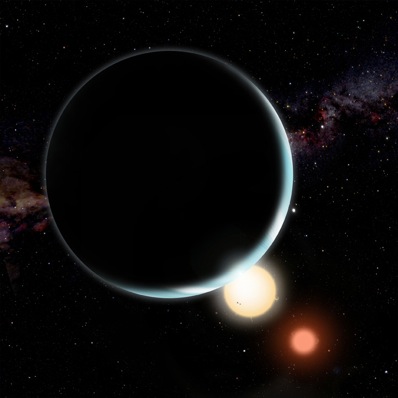 Kepler-16b, shown in this artist's conception, enjoys double sunsets as it circles a pair of stars. Image: David A. Aguilar (CfA) The Kepler spacecraft detected the planet using the transit method, that is, looking for the periodic dimming in a star as a planet moves across its face, temporality blocking out some of its light. The detection of Kepler-16b was complicated by the fact that the two stars in the system also eclipsed each other, but since the stars' brightness dropped even when the stars were not in eclipse, the presence of a third body was inferred. The additional observation that the dimming events occurred at irregular time intervals meant that the stars were in different positions in their orbit each time the third body passed, showing that it was circling both stars. "I was hoping to find a circumbinary planet in the Kepler data, but Kepler-16 is better than anyone imaged," Doyle tells Astronomy Now. "The orbits are so exquisitely aligned – the stars with each other and the planet with them – that we have been able to determine the size and mass of each of the stars and planet with unprecedented accuracy." Both stars are smaller and cooler than our own Sun, and are orbited by Kepler-16b once every 229 days at a distance of 65 million miles. Follow-up observations by the Tillinghast Reflector Echelle Spectrograph (TRES) on the 60-inch telescope at the Smithsonian Astrophysical Observatory’s Whipple Observatory in Arizona revealed that the two stars orbit each other every 41 days at an average distance of 21 million miles. Doyle reveals that there are "some good candidates" for further circumbinary planets in the Kepler dataset. "Now that we know how to find them, I think we are going to have quite a few more in the next several months," he adds. The results of the discovery are featured in this week's edition of the journal Science. |
|
|
|
|