

|
|
|
   |
|
Hot gas heads for black hole by Phil Unsworth for ASTRONOMY NOW Posted: 01 August 2011 
The Chandra X-Ray Observatory has, for the first time at X-ray wavelengths, clearly imaged hot gas being drawn towards a galaxy’s central black hole. “It’s exciting to find such clear evidence for gas in the grip of a massive black hole,” says Ka-Wah Wong of the University of Alabama. Wong led the study, published in the 20 July issue of The Astrophysical Journal Letters.  Galaxy NGC 3115 imaged in the X-ray part of the spectrum, showing the centre of the galaxy. Image: X-ray: NASA/CXC/Univ. of Alabama/K.Wong et al, Optical: ESO/VLT. According to previous work by Hermann Bondi and Raymond Lyttleton, black holes have a critical point in their vicinity, known as the ‘Bondi Radius’, within which gas will be predominantly affected by the black hole’s gravity. As gas passes this threshold it is squeezed, making it measurably hotter and brighter. The data from Chandra can now confirm this signature brightening, and suggests the rise in gas temperature begins approximately 700 light years from the black hole. From this it is thought that the black hole is about two billion times the size of the Sun. Located in the centre of galaxy NGC 3115, also known as the Spindle Galaxy approximately 32 million light years from Earth, this makes it the closest black hole of such a size to Earth. The new data will help astronomers understand a pair of astrophysical problems: how black holes grow, and how material behaves under their extreme gravity. Wong adds, “Chandra’s resolving power provides a unique opportunity to understand more about how black holes capture material by studying this nearby object.” 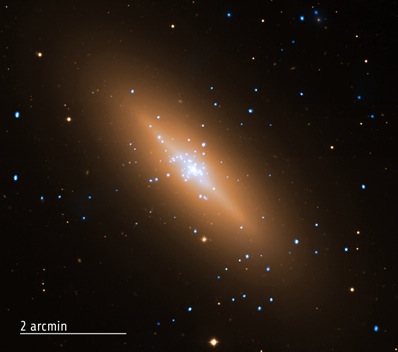 Composite image of NGC 3115 showing both the X-ray and the visual spectrum, with a scale. Image: X-ray: NASA/CXC/Univ. of Alabama/K.Wong et al, Optical: ESO/VLT. Based on Chandra’s observations of the gas’ density, and making some theoretical assumptions, it is estimated that an amount of gas equal to two percent of our Sun is being sucked in by the black hole per year – approximately 40,000,000,000,000,000,000,000,000 tonnes! However the Spindle Galaxy’s centre is not without raising its own questions. Assuming theories of energy-into-radiation change are correct, then the source in NGC 3115 is inadequate, being a million times too dim. “A leading mystery in astrophysics is how the area around massive black holes can stay so dim, when there’s so much fuel available to light up,” says Jimmy Irwin, also of University of Alabama, and co-author of the study. “This black hole is a poster child for this problem”. Again, either theories of energy change efficiency are incorrect, or not all the material that enters the Bondi Radius falls onto the black hole. Solving this mystery will fall to future observations. |
|
|
|
|