|
|
|
   |
|
Saturn’s F-ring gets a fan KEITH COOPER ASTRONOMY NOW Posted: 20 July 2010 
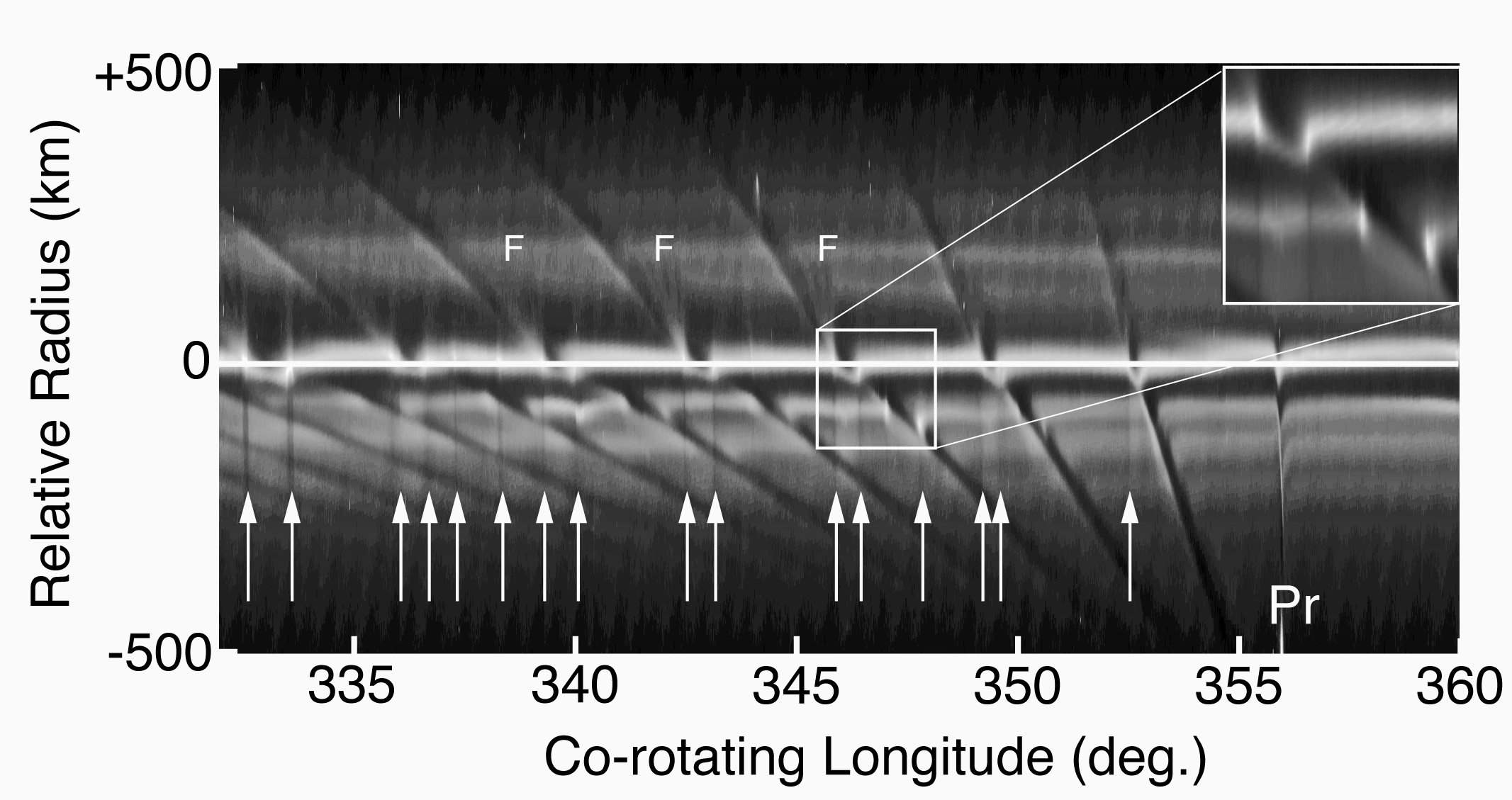
Looking very much like a concertina Chinese fan, Saturn’s F-ring sports intriguing dark ‘blades’ and bright steamers of ring material pulled out by the gravity of the ring’s shepherd moon, Prometheus, in these latest images from the Cassini spacecraft. The interaction of Prometheus with the ring results in the formation of clumps of ring material (ice and dust) into small moonlets as large as 20 kilometres across.  Clumps and fans in Saturn’s F-ring. Image: NASA/JPL/Space Science Institute. Clumps and fans in Saturn’s F-ring. Image: NASA/JPL/Space Science Institute.
Taken over a period of 23 hours and re-processed so the ring appears straight rather than curved, the images reiterate the fact that Saturn’s rings – and in particular its F-ring – are one of the more dynamic environments in the Solar System. When the F-ring was discovered in 1979 during the Pioneer 11 fly-by, it was found to be kinked thanks to the influence of its shepherd moons, and never seems to have exactly the same appearance twice. The primary protagonist is 148-kilometre wide, potato-shaped Prometheus. It orbits in an elliptical trajectory around Saturn, close to the F-ring, every 14.7 hours. Each orbit, when it reaches its farthest point from Saturn (a point called apoapse) and hence its closest point to the F-ring, its gravity is able to pull out bright streamers of ring material that are visible along the bottom of the image. Because Prometheus is moving around Saturn slightly faster than the F-ring, each apoapse occurs 3.2 degrees further along the ring on each orbit, thus creating a chain of streamers and fans.  Click here for larger version. The fans in the F-ring are marked with an F, while the arrows point to the clumps forming in the ring. Prometheus (marked Pr to the bottom right) appears as a bright streak. Image: NASA/JPL/Space Science Institute. Click here for larger version. The fans in the F-ring are marked with an F, while the arrows point to the clumps forming in the ring. Prometheus (marked Pr to the bottom right) appears as a bright streak. Image: NASA/JPL/Space Science Institute.
As Prometheus laps the ring material on its orbit every 68 days, it stirs up the particles in the ring, creating clumps that can grow under self gravity into small moonlets that cast long shadows. “Scientists have never seen objects actually form [in the rings] before,” says Cassini Imaging Team member Professor Carl Murray at Queen Mary, University of London. “We now have direct evidence of the rowdy dance between the moons and bits of space debris. Some of these objects will get ripped apart the next time Prometheus whips around, but some escape. Every time they survive an encounter they can grow and become more stable.” |
|
|
|
|