

|
|
|
   |
|
"Dropouts" pinpoint earliest galaxies DR EMILY BALDWIN ASTRONOMY NOW Posted: November 09, 2009 
By looking far back into the depths of the Universe, astronomers have found a galaxy located at just 787 million years after the big bang, and 22 other early galaxies. The big bang blasted the Universe into existence 13.7 billion years ago, and 400,000 years later, temperatures had cooled enough for electrons and protons to join and form neutral hydrogen. Within one billion years the first stars and galaxies were born. These new residents of the Universe radiated energy and ionized the hydrogen, initiating what is known as the reionization period. Astronomers know that this era ended about one billion years after the Big Bang, but when it began has remained something of a mystery. 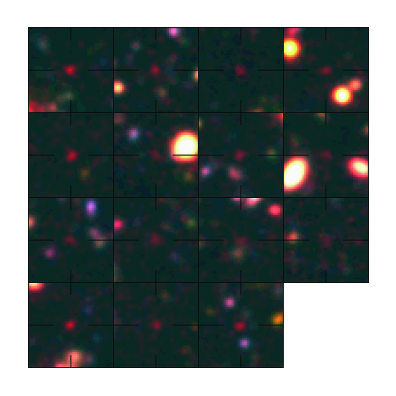 This is a composite of false colour images of the galaxies found at the early epoch around 800 million years after the big bang. The upper left panel presents the galaxy confirmed in the 787 million year old universe.Ê These galaxies are in the Subaru Deep Field. Image: M. Ouchi et al. This is a composite of false colour images of the galaxies found at the early epoch around 800 million years after the big bang. The upper left panel presents the galaxy confirmed in the 787 million year old universe.Ê These galaxies are in the Subaru Deep Field. Image: M. Ouchi et al.
Now, researcher Masami Ouchi of the Carnegie Observatories, and colleagues, have implemented a technique to shed light on the Universe's first brood of galaxies. “We look for ‘dropout’ galaxies,” says Ouchi. “We use progressively redder filters that reveal increasing wavelengths of light and watch which galaxies disappear from or ‘dropout’ of images made using those filters.” Older, more distant galaxies ‘dropout’ of progressively redder filters and the specific wavelengths reveal the galaxies’ distance and age. “What makes this study different is that we surveyed an area that is over 100 times larger than previous ones and, as a result, had a larger sample of early galaxies (22) than past surveys. Plus, we were able to confirm one galaxy’s age.” The hydrogen signature of one galaxy reveals its age as 787 million years post big bang, the first age-confirmation of a so-called dropout galaxy. Ouchi confirms that since all the galaxies were found using the same dropout technique, they are likely to be the same age. Ouchi's team made the observations using a custom-made, super-red filter on the wide-field camera of the 8.3-metre Subaru Telescope between 2006 and 2009 as part of the Subaru Deep Field and Great Observatories Origins Deep Survey North field. Using this data and that from other studies, they determined that star formation rates were considerably lower from 800 million years to one billion years after the big bang, than after this time frame. Accordingly, the rate of ionization would be very slow during this early time, due to the low star-formation rate. “We were really surprised that the rate of ionization seems so low, which would constitute a contradiction with the claim of NASA’s WMAP satellite. It concluded that reionization started no later than 600 million years after the Big Bang,” says Ouchi. “We think this riddle might be explained by more efficient ionizing photon production rates in early galaxies. The formation of massive stars may have been much more vigorous then than in today’s galaxies. Fewer, massive stars produce more ionizing photons than many smaller stars.” The research will feature in a December issue of the Astrophysical Journal. |
|
|
|
|