|
|
|

|
Substructure maps reveal dark matter clumps in galaxies YALE NEWS RELEASE Posted: January 6, 2005
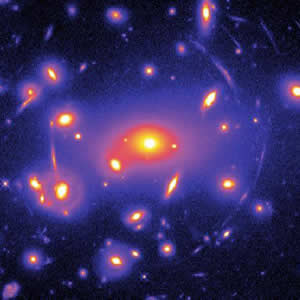
Clusters of galaxies (about a million, million times the mass of our Sun), are typically made up of hundreds of galaxies bound together by gravity. About 90 percent of their mass is dark matter. The rest is ordinary atoms in the form of hot gas and stars. Although little is known about it, cold dark matter is thought to have structure at all magnitudes. Theoretical models of the clumping properties were derived from detailed, high-resolution simulations of the growth of structure in the universe. Although previous evidence supported the "concordance model" of a universe mostly composed of cold, dark matter, the predicted substructure had never been detected. In this study, Yale assistant professor of astronomy and physics, Priyamvada Natarajan, and her colleagues demonstrate that, at least in the mass range of typical galaxies in clusters, there is an excellent agreement between the observations and theoretical predictions of the concordance model. Using gravitational lensing made it possible for the observers to visualise light from distant galaxies as it bent around mass in its way. This allowed the researchers to measure light deflections that indicated structural clumps in the dark matter. "We used an innovative technique to pick up the effect of precisely the clumps which might otherwise be obscured by the presence of more massive structures," said Natarajan. "When we compared our results with theoretical expectations of the concordance model, we found extremely good agreement, suggesting that the model passes the substructure test for the mass range we are sensitive to with this technique." "We think the properties of these clumps hold a key to the nature of dark matter — which is presently unknown," said Natarajan. "The question remains whether these predictions and observations agree for smaller mass clumps that are as yet undetected." Co-author on the study, funded by Yale University, is Volker Springel, MPA, Garching, Germany.
Other collaborators include. Jean-Paul Kneib, LAM – OAMP, Marseille, France, Ian Smail,
University of Durham, U.K., and Richard Ellis of Caltech. |
|
|
|
|||||