|

Top Stories
 |
 |
|
|


The mystery of the missing sunspots explained
...An unusually slow-moving solar jet stream buried deep inside the Sun is causing the lack of sunspots and low solar activity, say scientists from the National Solar Observatory...
read more

Giant eruption reveals
dead star
...X-rays from an enormous stellar eruption which arrived at the Earth in August last year originated from a rare group of dead star known as a magnetar...
read more

Meteorite holds clues to Earth's cosmic roots
...The interstellar stuff that became incorporated into the planets and life on Earth has younger cosmic roots than theories predict, according to new analysis of a meteorite that fell in 1969...
read more
|
|
|
 |
Spaceflight Now +
 |
 |
|
|

Subscribe to Spaceflight Now Plus for access to our extensive video collections!
How do I sign up?
Video archive

STS-120 day 2 highlights
 Flight Day 2 of Discovery's mission focused on heat shield inspections. This movie shows the day's highlights.

Play

STS-120 day 1 highlights
 The highlights from shuttle Discovery's launch day are packaged into this movie.

Play

STS-118: Highlights
 The STS-118 crew, including Barbara Morgan, narrates its mission highlights film and answers questions in this post-flight presentation.

Full presentation
Mission film

STS-120: Rollout to pad
 Space shuttle Discovery rolls out of the Vehicle Assembly Building and travels to launch pad 39A for its STS-120 mission.

Play

Dawn leaves Earth
 NASA's Dawn space probe launches aboard a Delta 2-Heavy rocket from Cape Canaveral to explore two worlds in the asteroid belt.

Full coverage

Dawn: Launch preview

These briefings preview the launch and science objectives of NASA's Dawn asteroid orbiter.

Launch | Science

Become a subscriber
More video
 |
|
|
 |
|
|

New map shines light on Moon’s shadowed craters
BY DR EMILY BALDWIN
ASTRONOMY NOW
Posted: 19 June, 2009
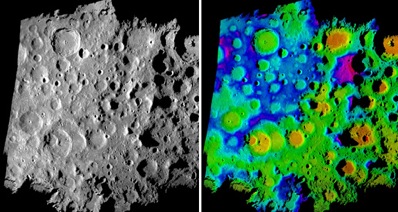
A new high resolution map of the Moon’s rugged south pole region provides new and unprecedented detail of permanently shadowed craters that could be hiding water ice deposits.
The discovery of water ice reservoirs on the Moon would be a significant step to the future of maintaining a long-term human presence on the Moon. “Since the beginning of time, these lunar craters have been invisible to humanity,” says Barbara Wilson of NASA’s Jet Propulsion Laboratory and manager of the study. “Now we can see detailed topography inside these craters down to 40 metres per pixel, with height accuracy of better than 5 metres.”

The black and white image on the left is a computer generated view of the pole from radar reflectance data. The colour image on the right is a topographic map of that same area and is the highest resolution topography map to date of the Moon's south pole.
The map was compiled using data from the Deep Space Network’s Goldstone Solar System Radar, which, in a two and a half second round trip, uses a 70 metre dish to send radar signals to the Moon that are reflected back and detected by two 34 metre antennas.
The Goldstone data was compared with laser altimeter data recently released by the Japanese Aerospace Exploration Agency’s Kaguya mission to position and orient the radar images and maps. The new map provides contiguous topographic detail over a region approximately 500 kilometres by 400 kilometres and will help scientists working on the Lunar Crater Observation and Sensing Satellite (LCROSS) to plan their encounter with a permanently dark crater close to the south pole.
LCROSS launched Thursday evening and along with its attached Centaur upper stage rocket will separately collide with the Moon, throwing up a pair of debris plumes which will be analysed for the presence of water ice or water vapour, hydrocarbons and other hydrated material.
Together with the Lunar Reconnaissance Orbiter, which also launched yesterday and will create further detailed maps of the lunar surface, NASA will be well-equipped for human exploration of the lunar south pole.
|
|
|
|
|
Infinity Rising
This special publication features the photography of British astro-imager Nik Szymanek and covers a range of photographic methods from basic to advanced. Beautiful pictures of the night sky can be obtained with a simple camera and tripod before tackling more difficult projects, such as guided astrophotography through the telescope and CCD imaging.
U.K. STORE
E.U. STORE
U.S. & WORLDWIDE STORE

Hubble Reborn
Hubble Reborn takes the reader on a journey through the Universe with spectacular full-colour pictures of galaxies, nebulae, planets and stars as seen through Hubble's eyes, along the way telling the dramatic story of the space telescope, including interviews with key scientists and astronauts.
U.K. STORE
E.U. STORE
U.S. & WORLDWIDE STORE

The Planets
From tiny Mercury to distant Neptune and Pluto, The Planets profiles each of the Solar System's members in depth, featuring the latest imagery from space missions. The tallest mountains, the deepest canyons, the strongest winds, raging atmospheric storms, terrain studded with craters and vast worlds of ice are just some of the sights you'll see on this 100-page tour of the planets.
U.K. STORE
E.U. STORE
U.S. & WORLDWIDE STORE

3D Universe
Witness the most awesome sights of the Universe as they were meant to be seen in this 100-page extravaganza of planets, galaxies and star-scapes, all in 3D!
U.K. STORE
E.U. STORE
U.S. & WORLDWIDE STORE

Mars rover poster
This new poster features some of the best pictures from NASA's amazing Mars Exploration Rovers Spirit and Opportunity.
U.K. STORE
E.U. STORE
U.S. & WORLDWIDE STORE
|