|
|
|

|
|
|
BY DR EMILY BALDWIN ASTRONOMY NOW Posted: 9 June, 2009 The discovery of new tidal debris stripped away from merging galaxies contains the full collision history, equivalent to being able to trace the skid marks on the road after a car crash, say astronomers. In the new study, a team of international astronomers used the 8.2 metre Subaru telescope on Mauna Kea, Hawaii to take deep exposures of archetypal colliding galaxies including the Antennae galaxies in the constellation Corvus, Arp 220 in the constellation Serpens and Mrk 231 in the Big Dipper. The images reveal the full history of galaxy collisions and resultant starburst activities, which are important in growing galaxies in the early Universe.
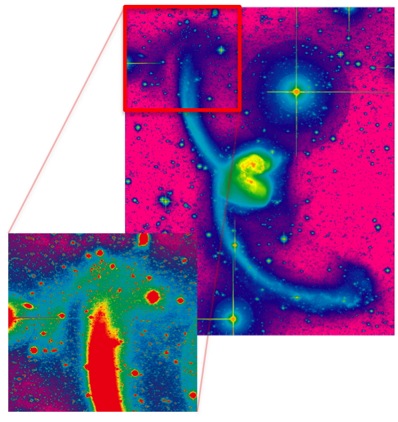
Deep exposure images of well known colliding galaxies reveal the true extent of tidal debris. This false-colour image shows the debris field around the Antennae Galaxies. Image: Koda et al. “We did not expect such enormous debris fields around these famous objects,” says Jin Koda, Assistant Professor of Astronomy at Stony Brook University. When a galaxy encroaches on another galaxy’s turf, gravitational attraction teases out tails of gaseous debris into spectacular patterns. In a full-on collision the galaxies will eventually merge, morphing into a single galaxy. “The new images allow us to fully chart the orbital paths of the The images reveal the extent of the debris to span a distance a few times wider than even the Milky Way Galaxy, but this isn’t always the case for galactic collisions. “The orbit and rotation of colliding galaxies are the keys,” says Koda. “Theory predicts that large debris are produced only when the orbit and galactic rotation synchronize each other. New tidal debris are of significant importance since they put significant constrains on the orbit and history of the galactic collisions.”
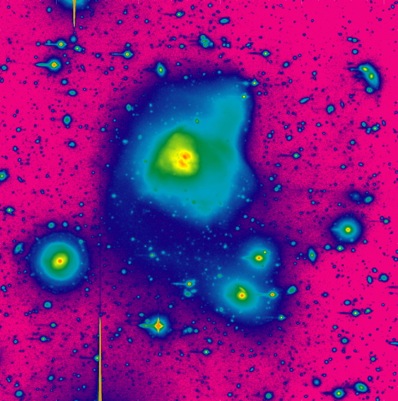
New detail around Arp 220 could shed light into starburst activity. Image: Koda et al. New tidal tails are characteristic of a quick merger, and could be the trigger of starburst activities in so-called Ultra Luminous Infrared Galaxies (ULIRGs). “Arp 220 is the most famous ULIRG,” says Yoshiaki Taniguchi, a professor at Ehime University in Japan. “ULIRGs are very likely the dominant mode of cosmic star formation in the early Universe, and Arp 220 is the key object to understand starburst activities in ULIRGs.” Further studies and detailed comparison with theoretical models may reveal the process of galaxy formation and starburst activities in the early Universe. |
|
|
|
||||||||||||||||||||||||||||||||||||||||||