|
|
|

|
|
|
NASA researchers have found a new mineral in a material that likely originated from comet 26P/Grigg-Skjellerup, which orbits the Sun once every five years. "When I saw this mineral for the first time, I immediately knew this was something no one had seen before," said Nakamura-Messenger, a space scientist at NASA's Johnson Space Centre in Houston. "But it took several more months to obtain conclusive data because these mineral grains were only 1/10,000 of an inch (0.00025 centimetres) in size." The mineral has been named ‘brownleeite’ after Donald Brownlee, a University of Washington astronomer who founded the field of interplanetary dust particle (IDP) research and is also the principal investigator of NASA's Stardust mission. The understanding of the early Solar System established from IDP studies would not exist without his efforts. "This really did surprise me because I know it took a lot of effort to get this mineral approved," says Brownlee. "I've always been very intrigued by minerals, so it's great to be one. I never dreamed I'd have a mineral named after me.”
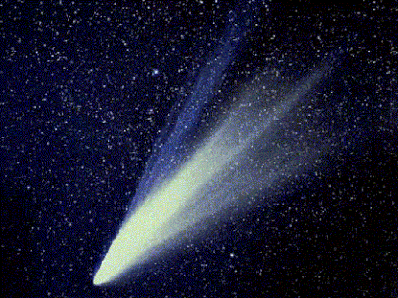
Comets contain pristine samples of the original building blocks of the Solar System. Image: Observatoire de Haute, Provence, France. The Earth collects an astounding 40,000 tons of dust particles every year from disintegrated comets and asteroids, equivalent to one particle per square metre of planet every day which therefore makes them very hard to find. This ‘gold-dust’ is extremely important because it is made of the original building blocks of the Solar System. NASA has routinely collected cosmic and interplanetary dust with high-altitude research aircraft since 1982, but this new particle was captured after an innovative method of collection was suggested by Johnson space scientist Scott Messenger, who predicted comet 26P/Grigg-Skjellerup was a source of dust grains that could be captured in Earth's stratosphere at a specific time of the year. The aircraft collected IDPs from this particular comet stream in April 2003 and the new mineral was found in one of the particles. "Because of their exceedingly tiny size, we had to use The mineral contains a combination of manganese and silicon (and is therefore known as a manganese silicide) and was surrounded by multiple layers of other minerals that also have been reported only in extraterrestrial rocks. It’s official name of brownleeite joins a list of over 4,300 other minerals.
|
|
|
|
||||||||||||||||||||||||||||||||||||||||||