|

Top Stories

|
|
| |
|

EPOXI checks out super-Earth planet
...the innovative Deep Impact spacecraft has now begun its new job as “super-Earth” planet hunter “EPOXI”...
read more
Second supernovae points to quark stars ...three of the most luminous supernova explosions ever observed could be the signatures of weird pseudo-stellar objects known as quark stars...
read more
When black holes snuff out star formation ...galaxies reaching a critical size of 10 billion times the Sun could see Active Galactic Nuclei take over from supernova explosions as the main mechanism to disperse star-forming ingredients...
read more
|
|
|
|
Spaceflight Now +
|
|
|
|
|
Subscribe to Spaceflight Now Plus for access to our extensive video collections!
 How do I sign up? How do I sign up?
Video archive
STS-120 day 2 highlights

Flight Day 2 of Discovery's mission focused on heat shield inspections. This movie shows the day's highlights.
Play
STS-120 day 1 highlights

The highlights from shuttle Discovery's launch day are packaged into this movie.
Play
STS-118: Highlights
The STS-118 crew, including Barbara Morgan, narrates its mission highlights film and answers questions in this post-flight presentation.
Full presentation
Mission film
STS-120: Rollout to pad

Space shuttle Discovery rolls out of the Vehicle Assembly Building and travels to launch pad 39A for its STS-120 mission.
Play
Dawn leaves Earth

NASA's Dawn space probe launches aboard a Delta 2-Heavy rocket from Cape Canaveral to explore two worlds in the asteroid belt.
Full coverage
Dawn: Launch preview
These briefings preview the launch and science objectives of NASA's Dawn asteroid orbiter.
Launch | Science
Become a subscriber
More video
|
|
|
|
|
|
Contact with ET may be sooner than we think
BY KEITH COOPER
ASTRONOMY NOW
Posted: June 5, 2008
It has been the question on the lips of astronomers ever since we began turning our radio telescopes to the skies and listening for extraterrestrial signals: where are they? Now a new study announced at the 212th American Astronomy Society Meeting in St Louis, Missouri, has suggested that we’ve been looking in the wrong places all along.
Beaming out radio messages all across the Galaxy would be an expensive and power hungry task. The only really powerful message that humanity has sent into space was in 1974, when a team led by Carl Sagan and SETI pioneer Frank Drake used the Arecibo radio telescope in Puerto Rico to beam a message containing information about humans and our Solar System to the globular cluster M13, 25,000 light years away. At the time, Carl Sagan reckoned that there was a fifty percent chance that there was an intelligent extraterrestrial civilisation in M13. Unfortunately, alien residents in other parts of the Galaxy would not be able to pick up the signal because it was not aimed at them. The Galaxy is so vast it would be unfeasible to send a message in every direction. This is one of the reasons why we have not sent any serious signals, barring the odd publicity stunt such as NASA beaming Beatles songs to Polaris, since 1974. What would be the point if we don’t know in which direction to send the message in the first place?
This has often troubled SETI researchers, who have turned this problem around and applied it to ET. Why would they take the time to beam messages in our direction if they don’t know we are here? This got Professor Richard Henry, of the Johns Hopkins Zanvyl Krieger School of Arts and Sciences, USA, thinking. How could ET know Earth is here? Henry reasons that an advanced civilisation would be capable of seeing the Earth transit the disc of the Sun.

As a planet transits in front of its parent star it temporarily blocks out some of the star's light, betraying the presence of an orbiting planet and telling scientists important information regarding the planet composition and size. Images: NASA/ESA/G Bacon (STScI).
Watching for transits is a successful method that we use to find exoplanets – 51 have been discovered thus far via this method. When a planet transits a star, it passes in front of its star’s disc. This causes a dip in the star’s light that we can detect. The size of the dip tells us the size of the planet, and how often the dips occur informs us about how long it takes for the planet to orbit, and hence its distance from its star. Additionally, the planet’s atmosphere can absorb some of the star’s light, and consequently we can see absorption lines in the spectrum of the star that tells us about what the planet’s atmosphere is made of.
If ET was watching our Sun for transits, they would be able to see that our planet was about 12,700 kilometres in diameter, orbited the Sun every 365 days, and would also be able to tell that our atmosphere was mainly nitrogen/oxygen with water vapour and even industrial pollution. Hence, ET would know there was someone living here, and know to send messages in our direction if they wanted to open up a line of communication.
However, we can only see a transit of another planet if our point of view is roughly level with the plane of their solar system. The same holds true for transits of Earth across the face of the Sun. If ET were looking from directly above or below our Solar System, they would see nothing. However, if they were level with the plane of our Solar System, they would see us. In the night sky, the plane of our Solar System is the ecliptic. Henry thinks that if there are any signals being broadcast to us, they will be coming from here.
“If those civilisations are out there… [then] those that inhabit star systems that lie close to the plane of the Earth’s orbit around the Sun will be the most motivated to send communications signals toward Earth,” says Henry. “Those civilisations will surely have detected our annual transit across the face of the Sun, telling them that Earth lies in a habitable zone, where liquid water is stable. Through spectroscopic analysis of our atmosphere, they will know that Earth likely bears life.”
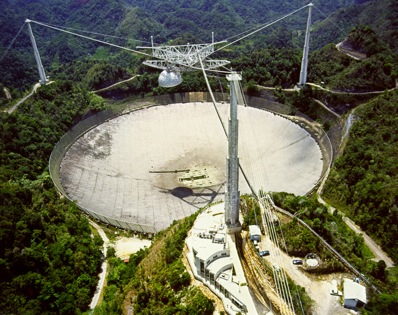
In 1974, the Arecibo radio telescope in Puerto Rico was used to beam a message containing information about humans and our Solar System to the globular cluster M13, 25,000 light years away. Image: NAIC-Arecibo Observatory/NSF.
Now Henry is willing to put his theory to the test. He has developed his theory with Seth Shostak of the SETI Institute in California and Steven Kilston of the Henry Foundation Inc. in Maryland, and they plan to use the SETI Institute’s Allen Telescope Array of radio dishes to search the ecliptic. The Allen Telescope Array, when fully constructed, will be made up of 350 six-metre radio dishes in California. Currently, 42 dishes are up and running, and the rest are expected to be ready in three years. Because the ecliptic only makes up three percent of the sky, this will drastically shorten the search.
“The crucial implication is that this targeted search in a favoured part of the sky – the ecliptic stripe if you will – may provide us with significantly better prospects for detecting extraterrestrials than has any previous search effort,” says Kilston.
For more information about the SETI Institute and the Allen Telescope Array, visit http://www.seti.org, and to keep track of our own exoplanet discoveries visit the excellent Exoplanet Encyclopedeia at http://exoplanet.eu. Also, check out the April 08 edition of Astronomy Now for a special series of articles on SETI.
|
|
|
|
|
|